

On day 02, we started the session with Saad A Akash, Engineering Manager at CCP/Kickstarter, also a jury member of various national and international blockchain olympiads, hackathons and robotics contests. In this session, he talked about the Design Thinking Process, Personas, the Kuleshov Effect in Films, Fidelity in Design Thinking, the Thought Experiment on Barbie, Ken and Oppenheimer, Design Systems and Architecture, User-Centered Design (UCD) + Human-Computer Interaction (HCI), UI and Usability, Interfaces and Communities, Product and People, UX Research, Prototyping, Interaction Design for Usability, Visual Perception and Visual UI, Accessibility, Readability and Legibility, Expert/Heuristic Evaluation and Benchmarking, Feedback Loop, Errors and Iterations, AI Hallucinations.
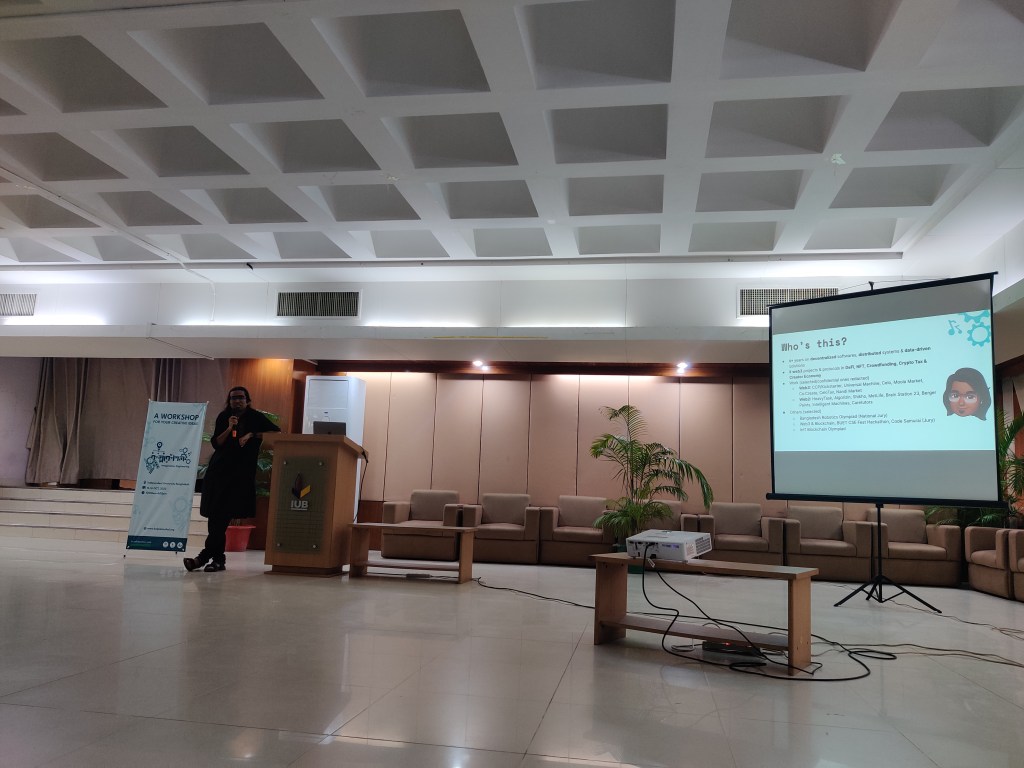
Design Thinking focuses on the human-centred side of creative problem-solving to understand the people you are trying to design the product for. There are a few steps in the Design Thinking process – Empathize → Define → Ideate → Prototype. Throughout the session, (while we were busy making our hands dirty with breakfast, the speaker was like, hey, enjoy your breakfast and design), we were given a situation like this: “If you notice one of your close person or friend is going through depression, what would you do or what would you offer?” Meanwhile, every student was given six different colours of paper hats (⚫ black, 🔵 blue, 🔴 red, 🟢 green, 🟡 yellow, and ⚪ white) to do an exercise named the “Six Thinking Hats (created by Edward de Bon, in 1985).” We can imagine “Six Thinking Hats” as a tool to look at a problem from many angles without arguments. People can use it alone or with others to break free from their usual thoughts, test different ideas, and find positive ways to progress. Each colour represents a theme, opinion or problem-solving method. Participants with black hats came out with a solution that (as they are cautious about the problem) they will encourage their friends to seek professional help and point out the potential risks of not getting help because depression is a serious condition, and it’s important to address it with expert guidance. When I got the green hat, I thought it would be better not to give my friend a specific solution at first. Rather I can start with the empathize step where we will talk to each other for deeper observation of that problem. In the ideate step, we can sketch at most 4-5 radical ideas that we can come up with. After that, I will share solutions with my friend and capture his/her feedback. Then based on his/her solution, I will generate a new solution and share it with my friend and get feedback. Then we all build a prototype of that design. So maybe the person likes photography, we can go to a photo exhibition where my friend will get new photography ideas and that might help him to cope with the solution.



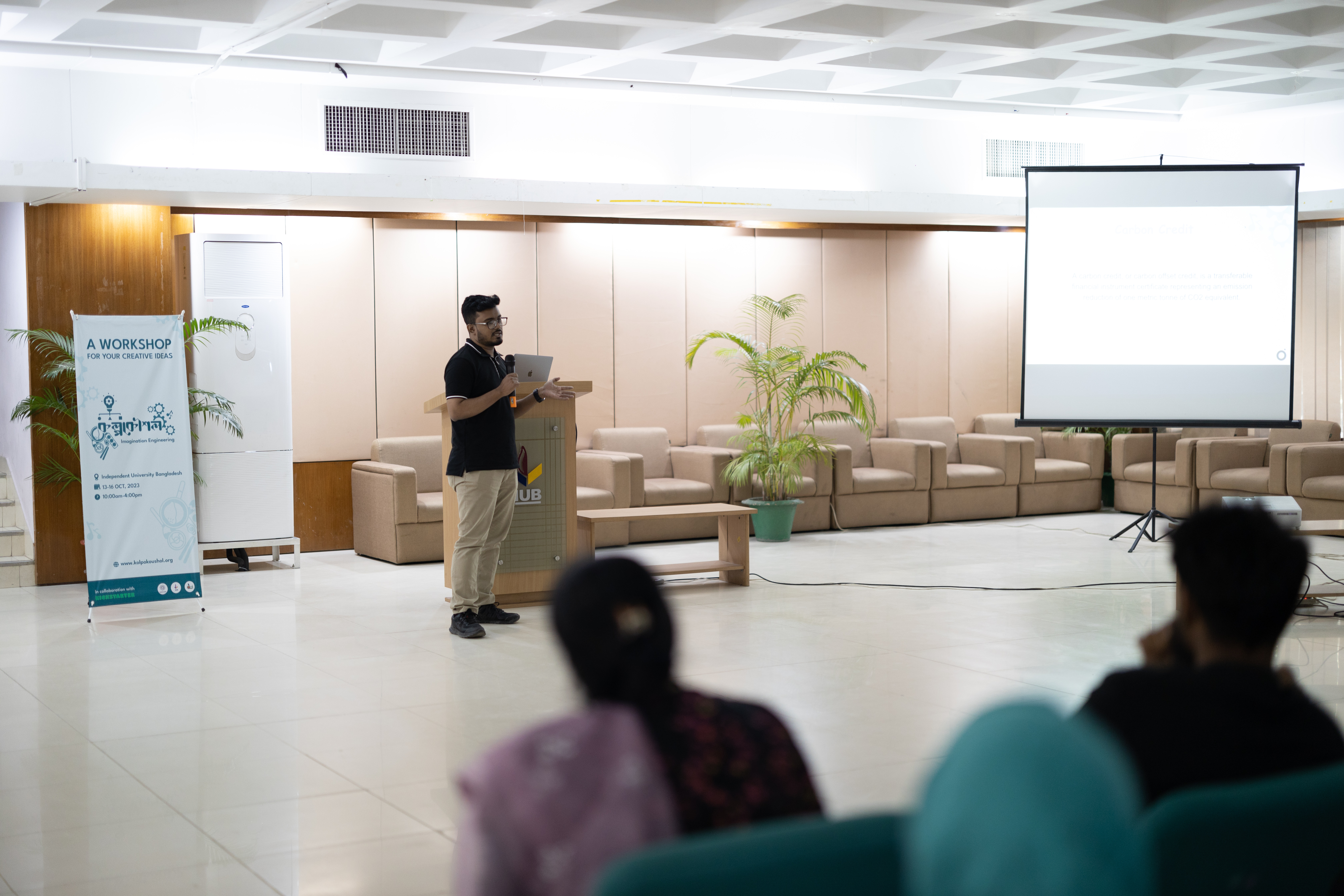
After that, we started our next session on Web3, Blockchain and Decentralization, presented by three blockchain experts from Kickstarter, Universal Machine and Oneshot.Earth. One thing that amazed me was people can earn or invest money in carbon credit or carbon offset credit. Just imagine, how much cleaner and clear the environment we will get if we can reduce extra carbon from the environment. In carbon offsetting, a group of people is producing emissions and another group of people reducing emissions by offsetting it. Oneshot.Earth believes that “Stopping 1 tonne of CO2e emissions today is more important than stopping 1 tonne of CO2e emissions tomorrow.”

After our lunch break, we started working on our project. We came up with an idea where we will start creating a musical instrument that will help people with special needs and traditional musicians or people as well and can play multiple instrumental music in one simple instrument. It was a big excitement and breakdown at the same time because the KolpoKoushol band will perform this on our demo day. At first, we thought we would build something that would create music with body movement but then we found out, that creating music with body movement will take time and for on-stage performance, we need something that will not waste our time and give music instantly. So we gathered together and divided our work. Two engineers from my team will help us with hardware setup and coding. The rest of the team will help to design the instrument and research on musical chords, scales and notes. Day 2 was getting a bit tougher and slower for us because we were struggling to design a traditional flute in a unique design but it was tough to measure the hole point in that flute. And here comes the twist, we had a professional flutist as our mentor and a sound engineer in our team as well.

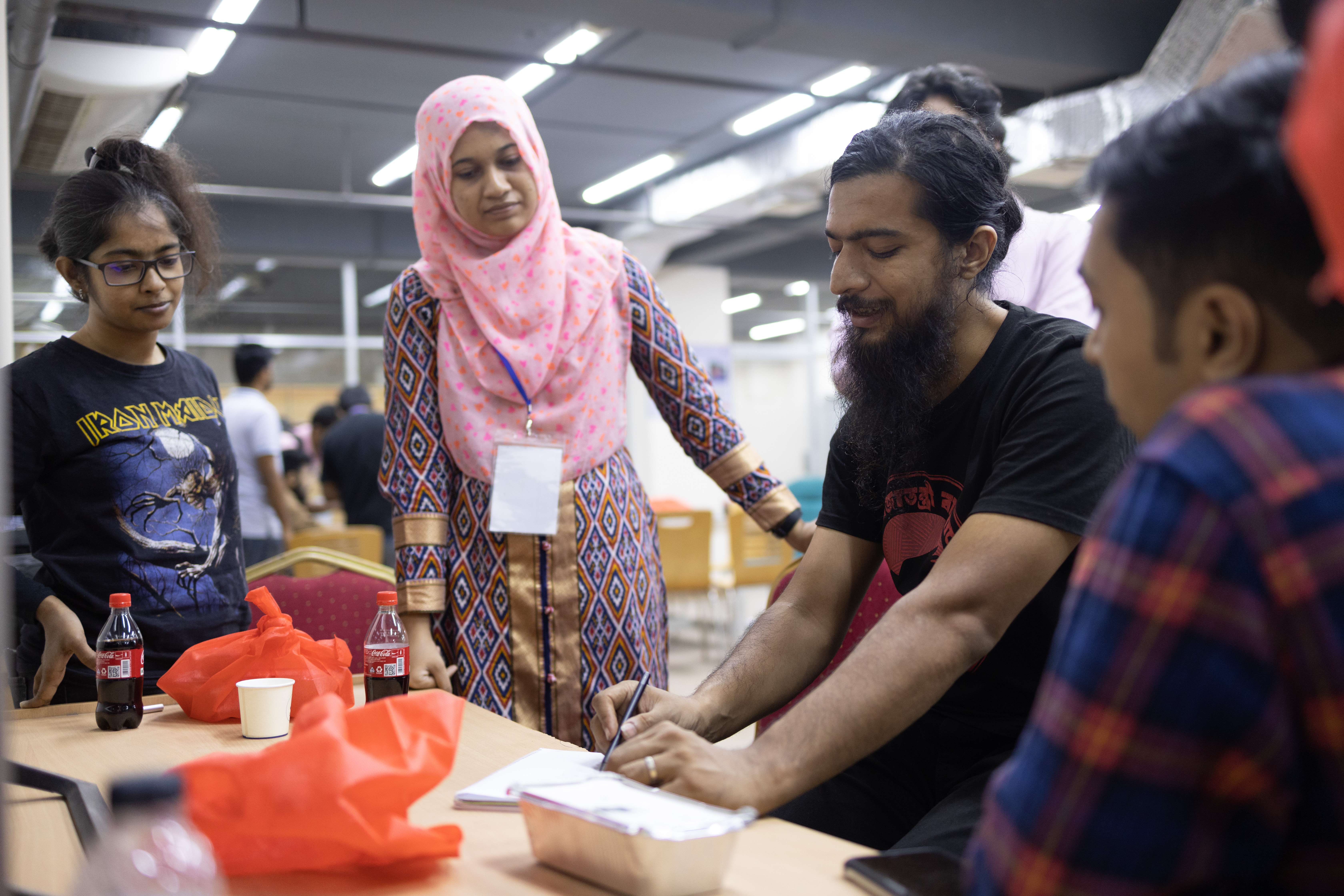
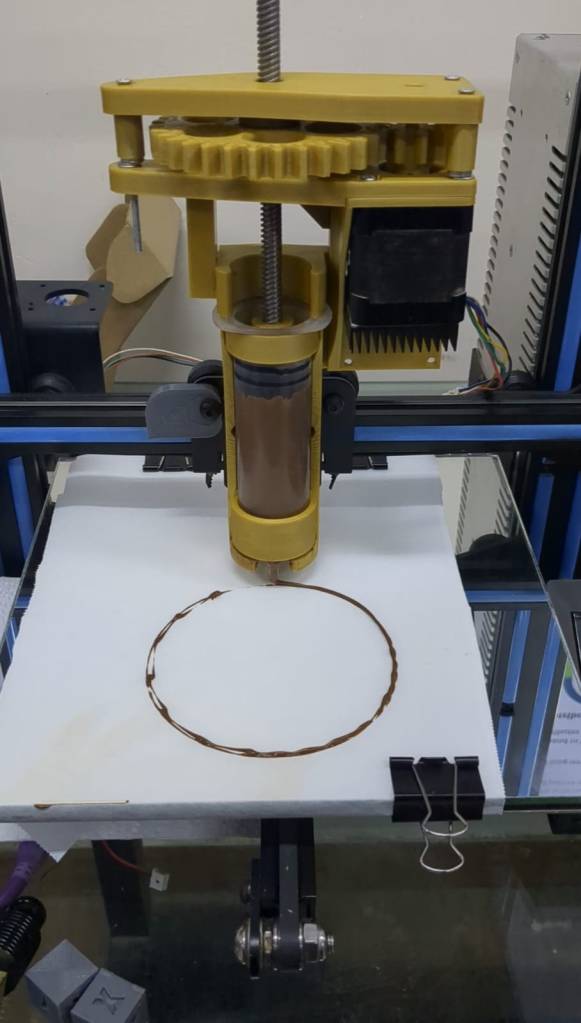
Day 2 was all about figuring out the easiest solution but whatever the idea we were planning to implement, it needed every different skill to learn within a short time. So we planned to set up the hardware and software part first with Arduino. Meanwhile, I planned to work on the design and figure out how a 3D printing machine works, how to make a design for 3D printing with Fusion 360 and how we can use a laser cut machine.
As I said, the first day was all about cool things, but the second day was about learning new skills. Nevertheless, as we stand here on day 4, what we’re looking forward to most is being able to execute these ideas the best that we can. Though we left the lab, we knew we had just one day more. Let’s see if we can dance in the music shower or not. In this symphony of innovation, we were hoping on day 2 that we’ll find our rhythm soon, and together, make our ideas soar.
 Zarin T.